Post2026-09-28Hosting Tycoon5 min
0049 · Running a game server network
Hosting Tycoon is a management game about the people who keep online games alive: the ones renting the machines, opening the servers and staying up when the lag hits. This first look inside the game is about its heart: game servers.
It starts with one server
You begin with a small budget and a single game license. Before you open your first server, you make three choices:
- The game. Every game has its own audience and its own rhythm. A voxel sandbox lives on voting sites and community word of mouth. A survival shooter lives on the in-game server browser and on wipe days.
- The concept. Survival, creative, skyblock, prison, an arena mode, a whole minigame network. Each concept attracts a different kind of player and asks for different add-ons.
- The machine. This is where the first real lesson waits.
Cores are not everything
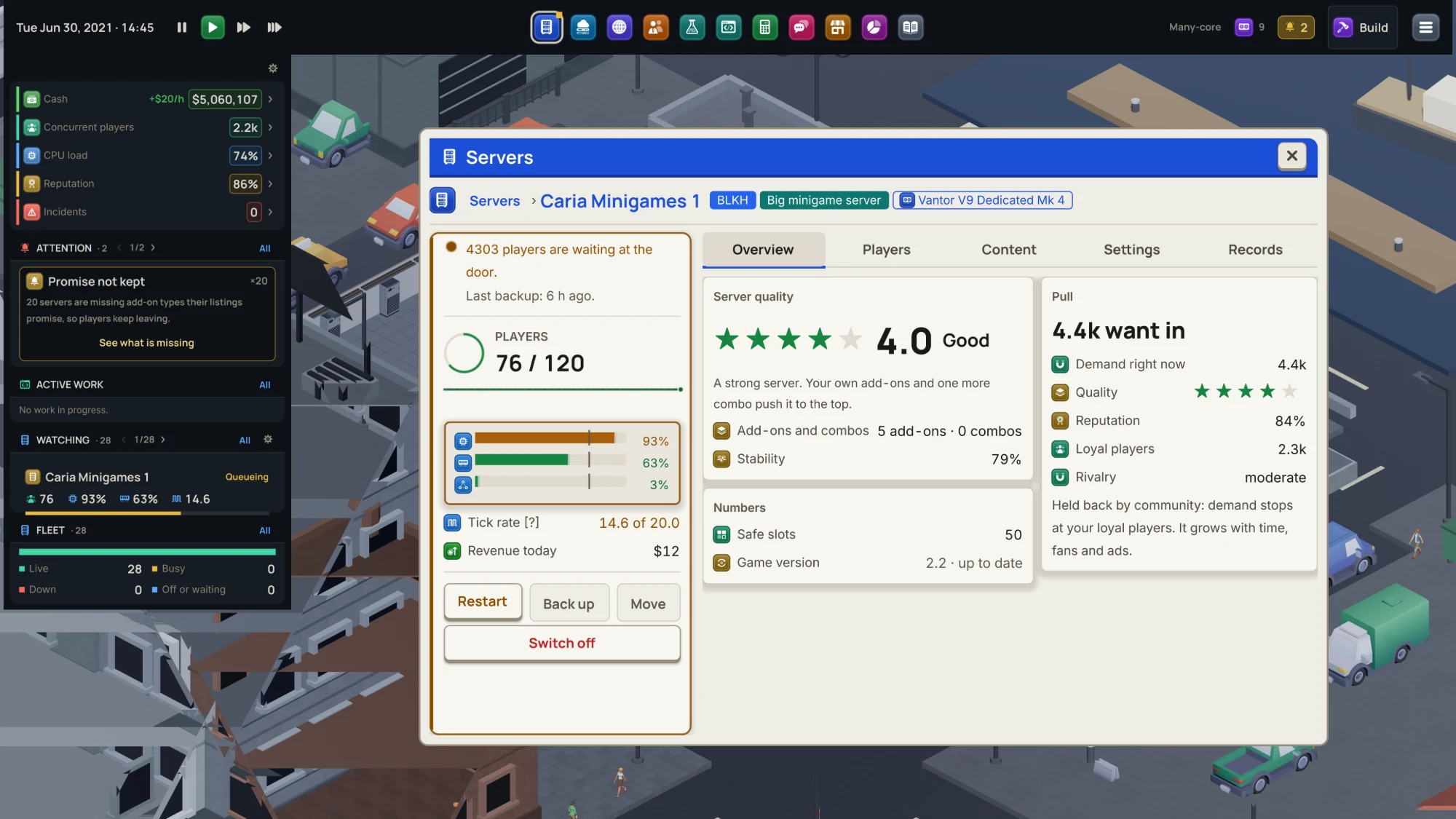
In the screenshots you are looking at Caria Network, a minigame network I built inside the game. It runs 28 servers behind a proxy, with lobbies, minigame and arena instances, islands, survival, a prison and a build world. At the moment of the screenshot, 2,200 players are online and more than 4,000 are waiting at the door.
Look closely and the numbers seem not to agree: the server page says 76 players, the top bar says 2.2k. Both are right. The page is showing one server, Caria Minigames 1, and it is only one of the 28 in the network. A proxy sits in front of all of them and joins them under a single address: players connect once, land in a lobby, and move between the minigames, the islands and the prison without ever leaving. From the outside, on a voting site or a server list, the whole network looks like one very big server.
That is how networks reach numbers no single server could hold. This one has 120 slots and will never fit more; the network simply adds servers behind the proxy as it grows. The 2,200 in the top bar are spread across all 28 of them.
My first attempt at this network failed, and it failed in an honest way. I put it on a 96‑core rack unit and it looked powerful on paper. Then one big minigame server dropped to 1 TPS. Players complained that "blocks keep snapping back," satisfaction collapsed and the network stopped growing.
The reason: a game server mostly runs on one thread, and those 96 cores were slow. I moved the same network to fewer but faster machines. Tick rate came back to 14‑18 and players started to stay. The game grew the fan base by itself from there. I did not type a single player number into that screenshot. The game produced them.
Hosting Tycoon is full of lessons like this. Real server admins will recognise them, and new players learn them by watching their community react.
Players don't just "arrive"
Demand in Hosting Tycoon is built from four things: quality, reputation, a loyal fan base and competition.
- Add-ons and combos raise quality. The right add-ons for your concept matter, and some of them work better together.
- Loyal players are your long-term capital. They come back after a wipe and they bring friends.
- Campaigns (vote campaigns, paid ads, working with streamers) bring new players. If the server is bad, they don't stay.
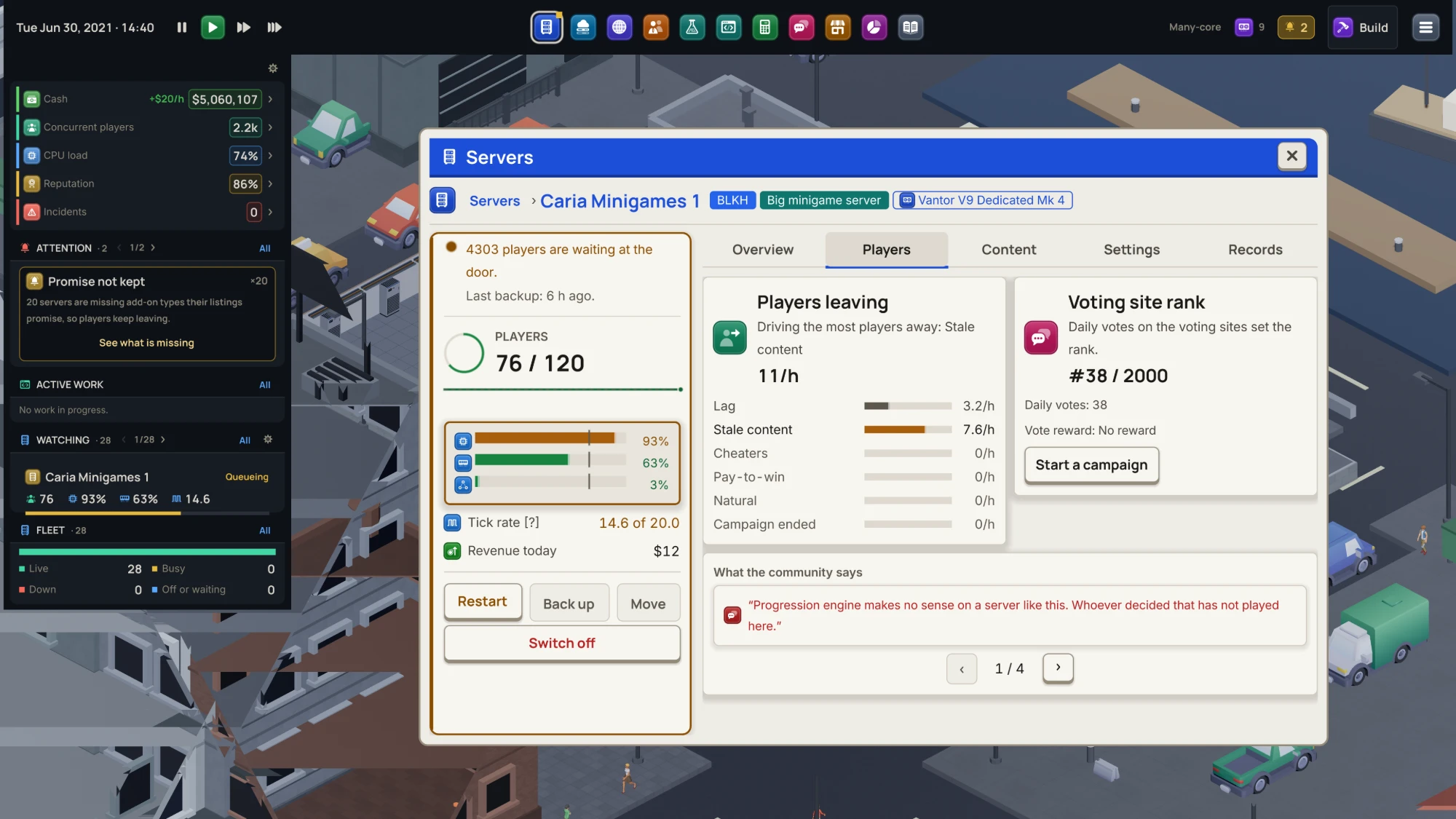
- Churn has reasons, and the game shows them: lag, stale content, cheaters, pay‑to‑win anger. Each server has a Players tab that tells you who is leaving and why, next to what the community is actually saying.
And then everything that can go wrong
Disks fail, so you need backups. The game you host ships a major update, and your server falls behind until you update. Cheating grows, so you run anticheat or sweep the server yourself. The machine gets hot and full, and you move servers between machines. None of these are menus to click once. They are decisions that cost time, money or downtime.
Easy to reach, deep to play
The interface is one of the things I have spent the most time on in this game, and it is still the part I rework most. A management game lives on its screens: you spend hours reading them, and every decision starts with something you noticed there.
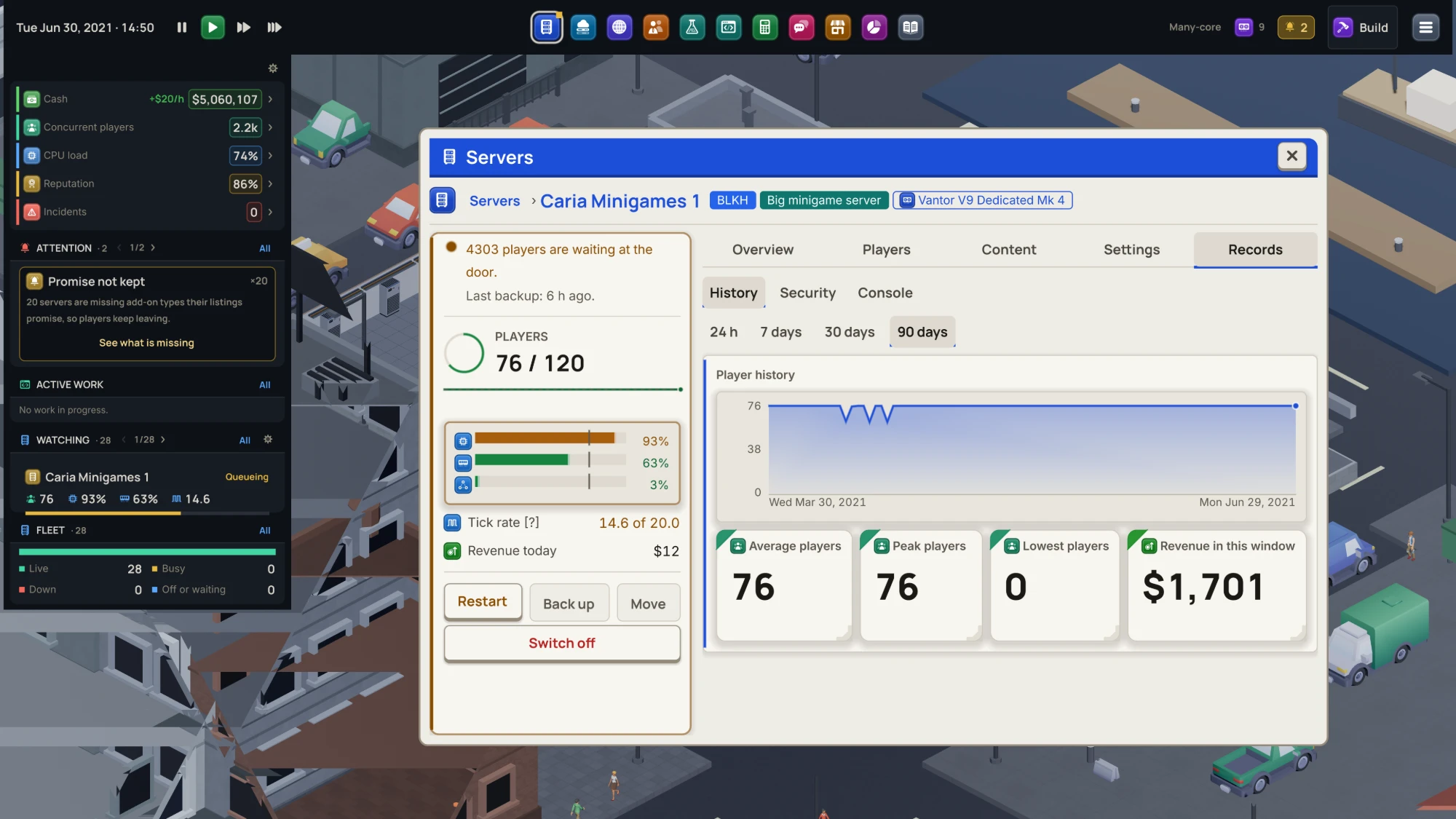
The balance I keep chasing is this: everything should be within reach of someone who opened the game an hour ago, and nothing should be flattened for the player who wants to know exactly why a server is losing eleven players an hour. So each page answers the first question at a glance (is this server healthy, and what does it need?) and then lets you keep pulling on the thread: from a star rating to the add-ons behind it, from a churn number to the reasons, from today's revenue to ninety days of history.
What is happening right now always sits in the same place on the left, so you never lose it while you dig. The depth is there when you go looking for it, and out of the way when you don't.
Hosting Tycoon is in development by Caria Core. Follow along at hostingtycoon.net.