Yazı2026-10-055 dk
0051 · Your audience, and the players who talk to you
EN, henüz çevrilmedi
13 October 2026: Hosting Tycoon is no longer a game of its own. Part of it is going into Project Silicon. Why, and what changes.
Last time I wrote about game servers: the machines, the tick rate, the network behind a proxy. This post is about the people on the other side of all that. In Hosting Tycoon they come in two sizes. There is your audience, the thousands of players, customers and subscribers who gather around everything you run. And there is a small group of players who actually talk to you.
A group that needs a server
When you start a new career, you pick a group to work for, a little like picking a storyteller in other management games. The group does not change your money or the rules. It changes what people ask of you and how they say it.
There are three of them, one for each road the game offers:
- Mortarloft are four friends who play a block-building game. They were tired of servers whose owners vanished, so you said "I'll host it."
- Gablenook is a small web agency. Its clients (a bakery, a dental clinic, a local team) need websites and virtual servers, and the agency wants to host them with you.
- Spannerkiln is a two-room startup that builds tools for server admins and wants to ship its first panel with you.
Whichever you pick, they are your first customer. Mortarloft plays on your servers, Gablenook rents your hosting, Spannerkiln becomes the first user of your software.
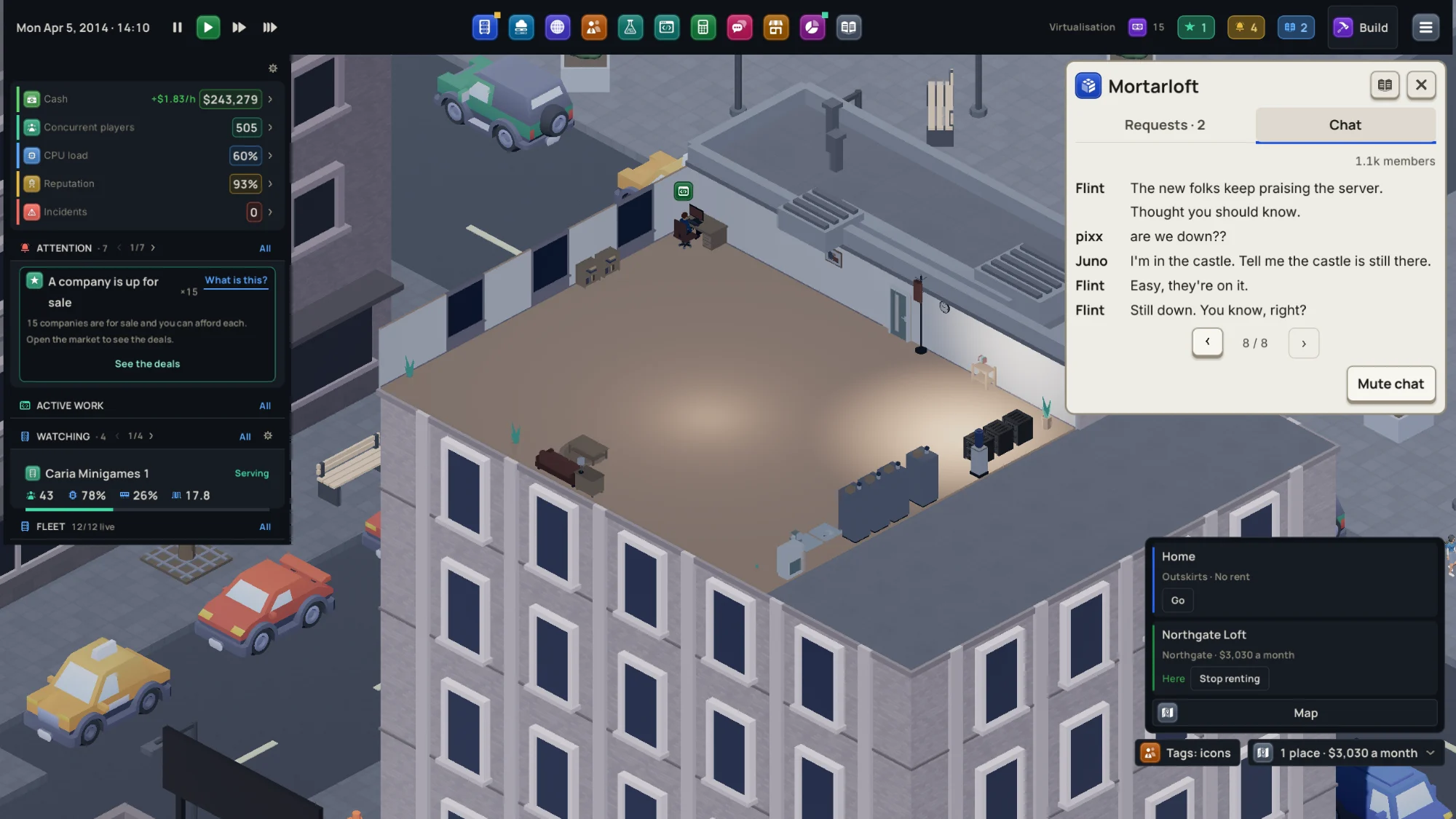
In the screenshots I am playing with Mortarloft: Flint, the calm founder who brings the requests; Juno, who builds castles and is terrified of losing one; pixx, the night owl who types in lowercase and spots lag before any graph does; and Ozzie, who works days, keeps the donation jar and answers everything with one dry line.
Requests, not quests
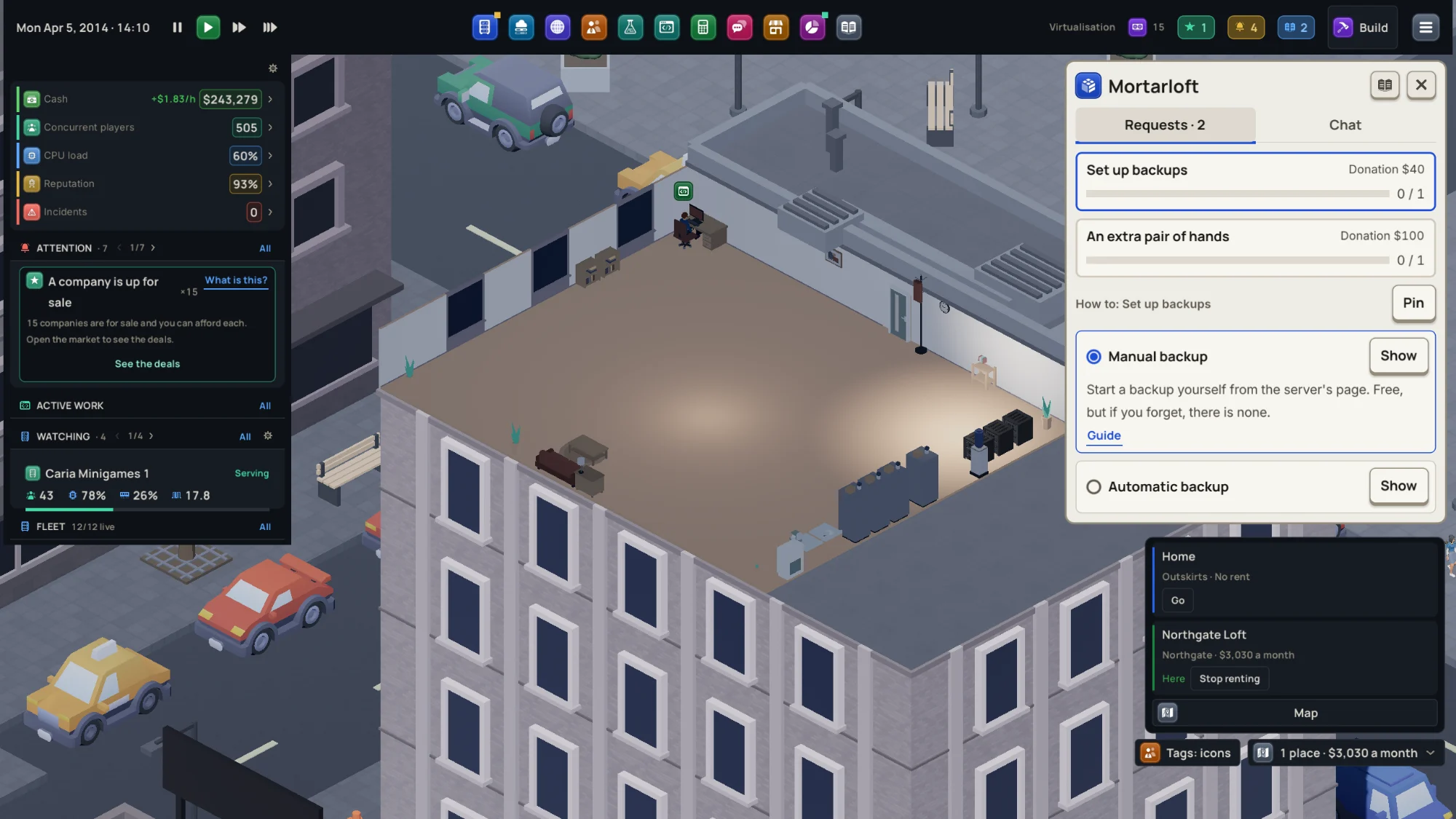
The group always has two or three open requests. Find a machine. Open a place for us. Set up backups. Bring the friends. Deal with the cheaters. You can pin one so it sits on a small card at the edge of the screen, but every open request counts, pinned or not.
A request is not a tutorial step with an arrow pointing at a button. It names a goal and lists the ways to reach it. For backups you can take them by hand from the server's page, which is free until the day you forget, or you can set up automatic backups. Pick a way, read how it works, press Show, and the game opens the screen where you do it.
There is no timer and no penalty. When a request is done the group sends a small donation and celebrates for a line or two. If you ignore one for a long time, someone will politely bring it up once. The last requests nudge you toward the other roads: a game group eventually asks about hosting, a hosting agency eventually wants a game night.
A chat that reacts to what really happens
The chat is the part I enjoy most. The group talks when a request opens or closes, and when something real happens on your servers: a crash, a long outage, a lag spike, a new player record, the first money coming in. If a server goes down at night, pixx will ask "are we down??" before you have even opened the server page.
I worked hard on the tone. They speak briefly, like friends in a channel, not like a tutorial. After the first hour they get quieter. If you would rather play in silence, you can mute the chat, and you can turn the group off entirely in the settings. In Hardcore and Sandbox there is no group at all.
One audience for everything you run
The group is four people. Your audience is everyone else, and it is a single thing.
Every firm in Hosting Tycoon has one community, like one big community channel. The fans of your game servers are in it. So are your hosting customers and the subscribers of your software. It does not belong to any single server, so when you open something new, the community comes with you.
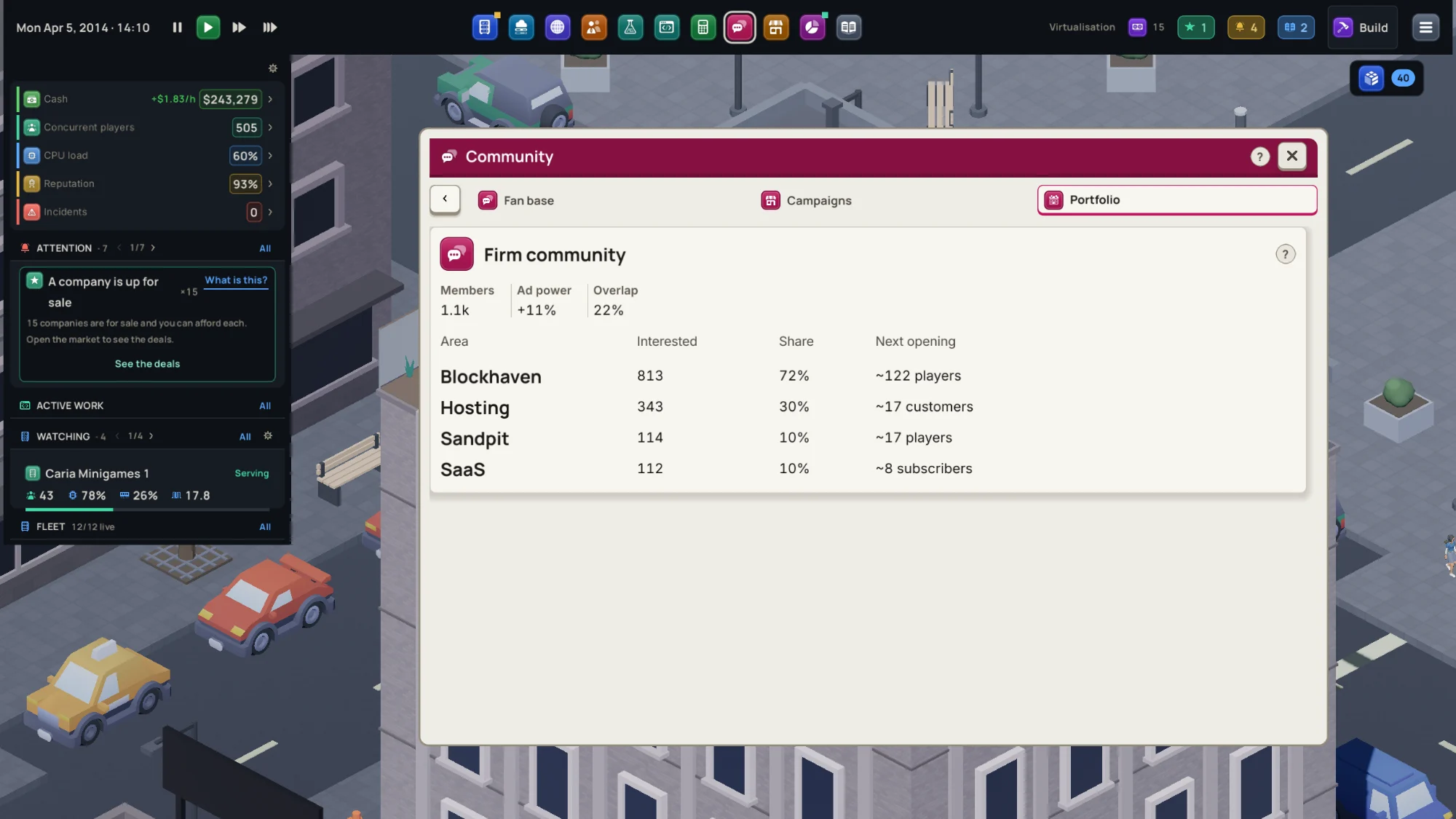
The Portfolio page shows it as an interest mix. Members are counted where they came from, but people follow more than one thing. A Blockhaven player might also care about the sandbox game you started hosting, or about the panel your studio sells. That overlap is why the shares add up to more than 100%.
In this run the community came almost entirely from a Blockhaven network, yet 114 members were interested in Sandpit, a game I barely hosted. That is the Next opening column: open another Sandpit server and it would start with about 17 players from your own community, before a single ad.
The first players come from home
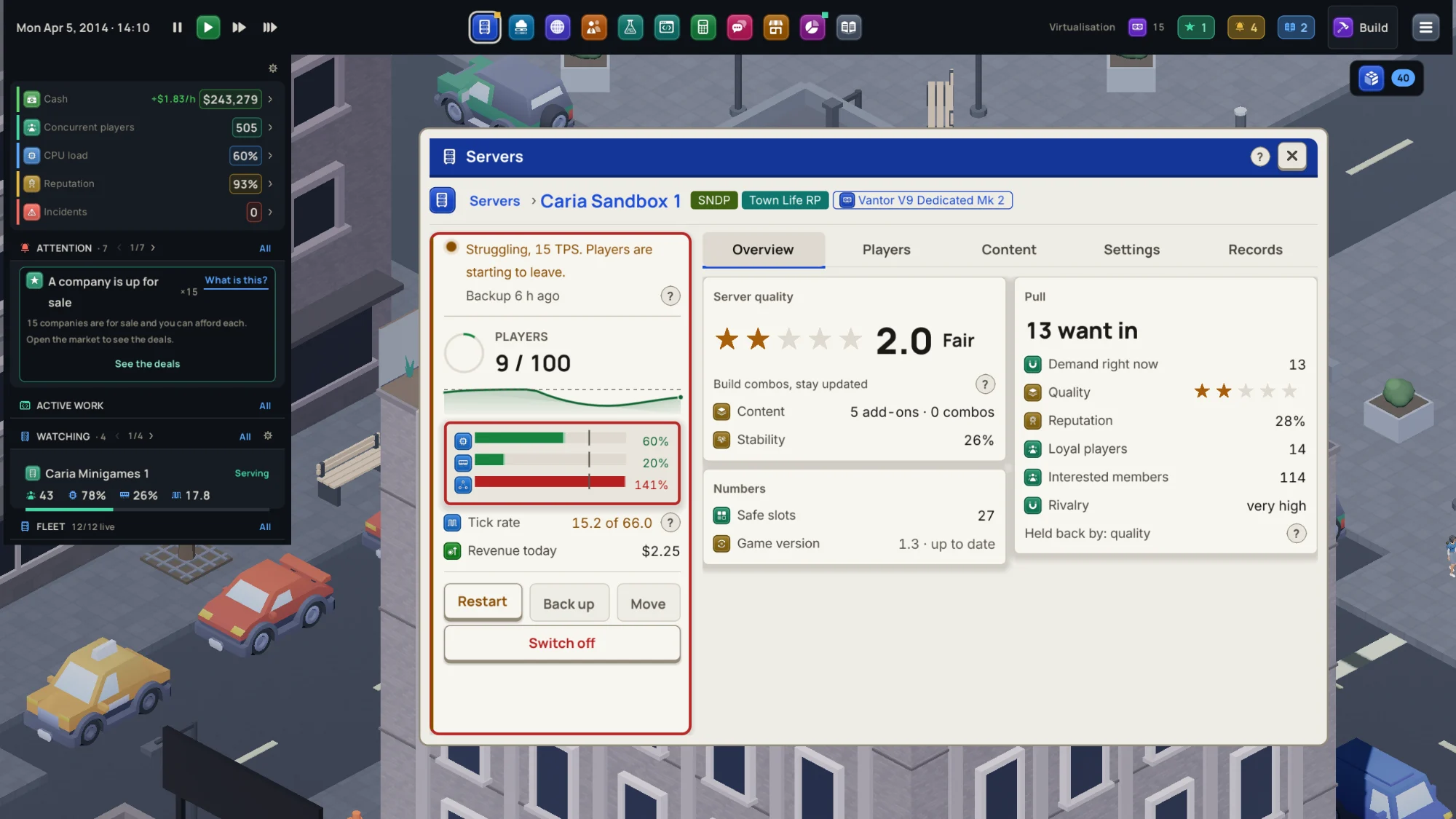
The rules behind this are simple, and I kept them that way on purpose:
- A new opening gets a head start once. A new game server, hosting plan or software product starts with a share of the members interested in that area. A good reputation makes the share bigger.
- The same people can't be spent twice. Interest you have used refills slowly, so opening five servers in a row does not give five head starts. A second server in the same game takes part of its start from your other servers, so there is no free growth.
- The community follows reality. Members drift toward your live audience. It grows quickly when you do well and shrinks slowly when you stumble, because people forget a good server late.
It gets wider as it grows
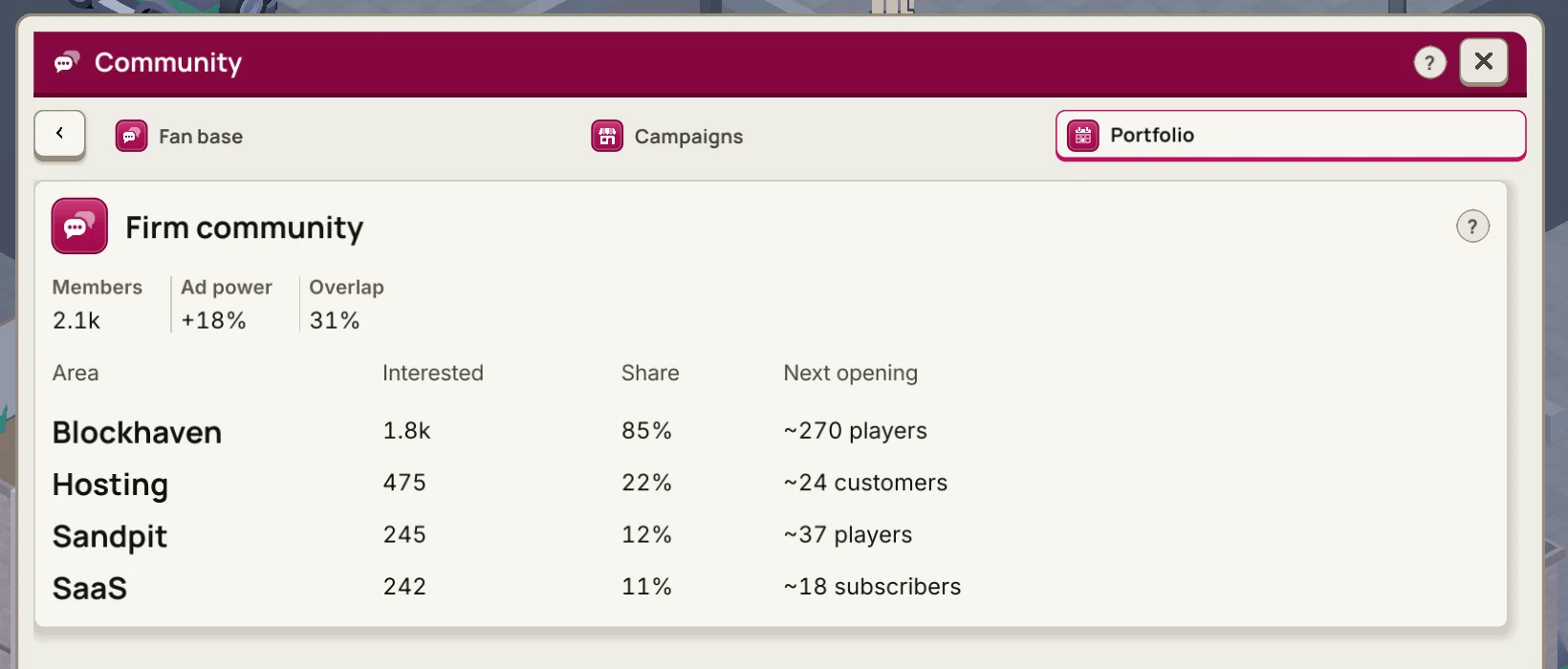
The bigger the community, the more varied it gets. A small community is mostly fans of your first game; a large one has people who follow everything you do. Between April and June this firm went from 1.1k to 2.1k members, and the overlap went from 22% to 31%. Software interest more than doubled, even though the products themselves barely grew.
Size also has a second effect, shown as Ad power. A large community carries your message further, so the same budget reaches more people: campaigns for your game servers, new leads for hosting, growth for your software. Here it went from +11% to +18%. A big community does not replace good servers, but it makes everything you open after them a little easier.
When the community passes a milestone, the group notices too. In this run, the day the channel reached a thousand members, pixx announced it in capital letters and Flint added that nobody had come for a trick.